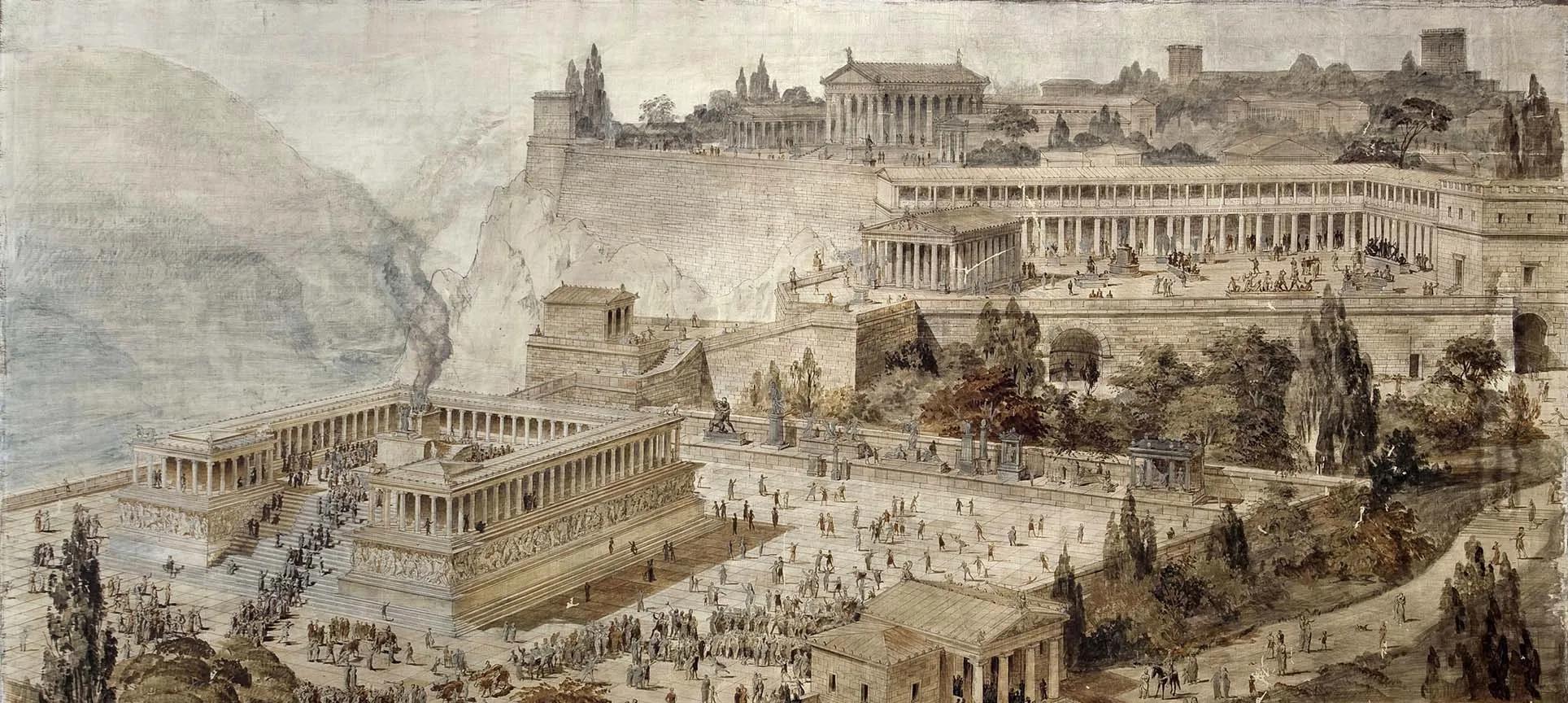
From the Acropolis to the Asclepion, from the Red Basilica to the Ottoman monuments — the principal sights of the ancient city and of modern Bergama.
The Acropolis
Crowning the heights above Bergama, the Pergamon Acropolis holds the steepest surviving theatre of the ancient world. This feat of engineering seats around 10,000 and looks out across the whole valley.
On the same hill stand the re-erected white marble columns of the Temple of Trajan and the remains of one of the greatest libraries of the Hellenistic age.
Terrace of the Great Altar
One of the most celebrated altars of antiquity stood here. Its sculpted friezes, showing the battle of the gods and the giants, were excavated by Carl Humann between 1878 and 1886 and taken to Berlin, where they are displayed in the Pergamonmuseum.
What you see at the Acropolis is the terrace, the foundations and the pines that surround them — the monument itself is no longer on site.
The Asclepion
One of the foremost healing centres of antiquity. Tradition holds that an inscription above its gate read: "Death may not enter here." The physician Galen began his career on this site.
Wherever Asclepius is depicted, the same staff is in his hand: straight, plain, with a single snake wound around it. The snake is no accident — an animal that sheds its skin and renews itself is healing made visible. Struck on Bergama's coins, that sign is still the emblem of medicine today. The winged rod with two snakes it gets confused with, the caduceus, belongs to Hermes.
The Ancient Aqueduct
The height of the Acropolis forced the city into some of the most ambitious water engineering of the ancient world. Water drawn from springs on Madra Dağı to the north travelled along a great line of fired-clay pipe segments, crossing the valleys under pressure as an inverted siphon to reach the city on the hill.
Remains of the arched stretches of that line can still be seen around Bergama.
The Red Basilica
A colossal temple dedicated to gods of Egyptian origin — Serapis and Isis — and one of the most imposing works of Roman brick architecture anywhere in the world. Part of it was converted into a church in the Eastern Roman period.
The Seljuk Minaret
This slender brick tower, standing since the 14th century, is among the oldest traces of the town's Turkish-Islamic identity. Despite its traditional name it does not date from the Seljuk period but from the age of the beyliks and the early Ottomans, added when an Eastern Roman building was converted into a mosque.
The Great Mosque
Built in 1399, in the reign of Sultan Bayezid I, the mosque reflects the elegance of early Ottoman architecture and the character the Turks brought to the city.
The Historic Arasta
For centuries the beating heart of the town, the Arasta is a singular trading quarter of narrow lanes and traditional shops where history still breathes inside modern Bergama.
The Bergama Museum
Opened in 1936, the museum brings together finds from the city's Hellenistic, Roman, Eastern Roman and Ottoman layers. Its sculpture, inscriptions and ethnographic collection supply the context for what you see at the Acropolis and the Asclepion.